
Diazepam for Seizure Control and Acute Anxiety: Understanding Its Use, Benefits, and Safety Protocols
June 13, 2025 2026-03-13 13:17Diazepam for Seizure Control and Acute Anxiety: Understanding Its Use, Benefits, and Safety Protocols
 thepsychestore doctor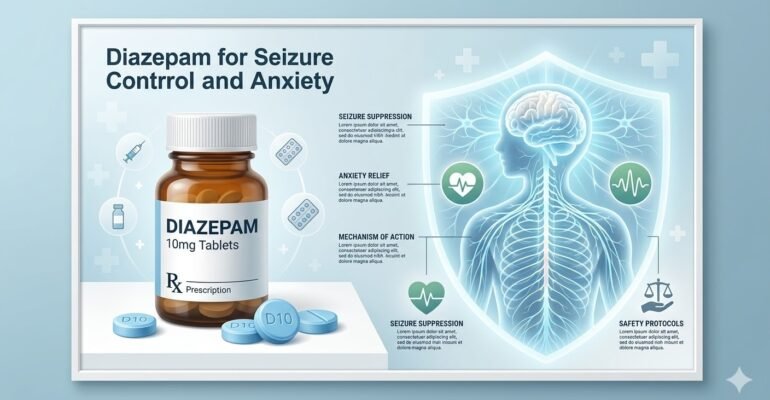
Diazepam for Seizure Control and Acute Anxiety: Understanding Its Use, Benefits, and Safety Protocols
Diazepam for Seizure Control and Acute Anxiety: Understanding Its Use, Benefits, and Safety Protocols
In this article
- What is diazepam and how does it work?
- FDA-approved uses: seizures, anxiety, and beyond
- Diazepam for seizure control
- Diazepam for acute anxiety
- Dosing, forms, and administration
- Who should not use diazepam
- Side effects and safety protocols
- Dependence, withdrawal, and long-term use
- Frequently asked questions
What is diazepam and how does it work?
Diazepam belongs to a class of medications called benzodiazepines — central nervous system (CNS) depressants that enhance the effect of gamma-aminobutyric acid (GABA), the brain’s primary inhibitory neurotransmitter. By increasing GABA activity, diazepam slows down abnormal electrical brain activity and reduces the physiological symptoms of anxiety.
Originally synthesized in 1959 and approved by the FDA in 1963 under the brand name Valium, diazepam quickly became one of the most prescribed drugs in the world. Today, it remains an essential tool in emergency medicine, epilepsy management, and short-term anxiety treatment — though prescribing practices have become significantly more conservative due to its high potential for dependence.
Diazepam acts quickly, reaching peak blood levels within 30–90 minutes when taken orally, and within minutes when given intravenously. It also has a long half-life of 20–100 hours, meaning its effects — and its active metabolites — persist in the body for an extended period.
FDA-approved uses: seizures, anxiety, and beyond
Diazepam is FDA-approved for several distinct clinical indications:
- Short-term relief of anxiety disorders and anxiety-associated symptoms
- Acute seizure management (including status epilepticus)
- Adjunct treatment for muscle spasm and spasticity
- Alcohol withdrawal syndrome management
- Pre-procedural sedation and anxiety reduction
- Symptomatic relief of acute agitation, tremor, and delirium tremens
Off-label uses include treatment of panic disorder, insomnia, restless leg syndrome, and certain forms of vertigo — though these should be carefully evaluated against the risk profile.
Diazepam for seizure control
One of the most critical roles for diazepam is in the management of acute seizures, particularly prolonged or recurring seizures known as status epilepticus — a life-threatening neurological emergency.
Status epilepticus: a medical emergency
Status epilepticus is defined as a seizure lasting longer than 5 minutes, or two or more seizures without full recovery of consciousness between them. Without prompt treatment, it can cause permanent brain damage or death. Diazepam is a first-line agent in this setting due to its rapid onset of action.
When administered intravenously in a hospital setting, diazepam can stop seizure activity within 2–3 minutes. The rectal gel formulation (Diastat) is widely used at home or in school settings for children with epilepsy who are at risk of cluster seizures.
Cluster seizures and at-home management
For patients with epilepsy who experience cluster seizures — multiple seizures in a short period — diazepam rectal gel or the nasal spray formulation (Valtoco) provides a non-IV rescue option that caregivers can administer outside of a hospital. This has dramatically improved safety outcomes for patients with refractory epilepsy.
How diazepam stops seizures
During a seizure, neurons fire abnormally and rapidly. Diazepam’s enhancement of GABA activity essentially slows this electrical storm by increasing the frequency of chloride ion channel opening in neurons — making it harder for the abnormal electrical activity to propagate. This mechanism is both fast-acting and effective across multiple seizure types.
Seizure types diazepam treats
- Generalized tonic-clonic seizures
- Status epilepticus
- Febrile seizures (children)
- Cluster seizures
- Focal seizures with impaired awareness
Common formulations used
- IV/IM (hospital emergency use)
- Rectal gel (Diastat — at-home rescue)
- Nasal spray (Valtoco — rescue)
- Oral tablets (adjunct/long-term)
Diazepam for acute anxiety
Anxiety disorders are the most common mental health conditions globally, affecting roughly 1 in 5 adults. While first-line treatments for chronic anxiety include SSRIs, SNRIs, and psychotherapy, there are situations where the severity of symptoms — panic attacks, acute situational anxiety, or severe generalized anxiety disorder (GAD) — calls for fast-acting pharmacological support. That is where diazepam may play a short-term role.
How diazepam reduces anxiety
By amplifying GABA’s calming effect on the nervous system, diazepam reduces the physiological and psychological components of anxiety: racing heart, muscle tension, hyperventilation, and intrusive worry. Effects are typically felt within 30–60 minutes of an oral dose, providing meaningful short-term relief.
Important: Diazepam is not intended as a long-term treatment for anxiety. Due to its significant dependence potential, most clinical guidelines recommend limiting benzodiazepine use for anxiety to 2–4 weeks, with a clear tapering plan. Long-term anxiety management should be built around therapy and non-benzo medications.
When diazepam may be appropriate for anxiety
- Short-term bridging while waiting for an SSRI or SNRI to take effect (typically 4–6 weeks)
- Acute situational anxiety (medical procedures, flight anxiety, etc.)
- Severe acute panic attacks unresponsive to other interventions
- Alcohol withdrawal-related anxiety and agitation
Dosing, forms, and administration
Diazepam dosing varies significantly depending on the condition being treated, the patient’s age, weight, liver function, and tolerance. The following are general clinical ranges — always follow the dose prescribed by your doctor.
Anxiety (adults)
- Typical: 2–10 mg, 2–4 times daily
- Duration: 2–4 weeks maximum
- Form: Oral tablets
Acute seizure (rescue)
- Rectal: 0.2–0.5 mg/kg (pediatric)
- IV: 5–10 mg, may repeat after 10–15 min
- Nasal: weight-based dosing
Muscle spasm (adults)
- Typical: 2–10 mg, 3–4 times daily
- Short-term use preferred
Alcohol withdrawal
- Loading dose: 10 mg initially
- Then 5–10 mg every 3–4 hours
- Close monitoring required
In elderly patients, doses are typically started much lower (1–2 mg) due to increased sensitivity and slower drug metabolism. The liver metabolizes diazepam, so patients with liver disease require careful dose adjustment.
Who should not use diazepam
Diazepam is contraindicated in several populations. Your prescriber will review your full medical history before recommending it.
Absolute contraindications
- Myasthenia gravis (neuromuscular disorder)
- Severe respiratory insufficiency or sleep apnea
- Acute narrow-angle glaucoma
- Severe hepatic (liver) impairment
- Known hypersensitivity to benzodiazepines
- Pregnancy (particularly first trimester — associated with fetal risk)
Use with caution
- History of substance use disorder or alcohol dependence
- Depression with suicidal ideation (may disinhibit)
- Elderly patients (high fall risk, cognitive effects)
- Breastfeeding mothers (diazepam passes into breast milk)
- Patients taking opioids, other CNS depressants, or alcohol
Black box warning: The FDA requires a black box warning on all benzodiazepines about the risk of severe respiratory depression, coma, and death when combined with opioid medications. Always inform your healthcare provider about all medications you are taking.
Side effects and safety protocols
Like all medications, diazepam carries a risk of side effects. Understanding these helps patients and caregivers use it safely.
Common side effects
- Drowsiness and sedation
- Dizziness or lightheadedness
- Muscle weakness or coordination problems (ataxia)
- Memory impairment or confusion
- Slurred speech
- Fatigue or low energy
Serious side effects requiring medical attention
- Severe respiratory depression (slowed or stopped breathing)
- Paradoxical reactions: increased agitation, aggression, or anxiety (more common in children and the elderly)
- Significant confusion, disorientation, or hallucinations
- Severe allergic reaction (rash, swelling, difficulty breathing)
- Suicidal thoughts or behaviors
Safety protocols for caregivers administering rescue doses
For parents and caregivers of patients using diazepam rectal gel or nasal spray for seizure rescue, clear protocols are essential:
- Know the exact prescribed dose for your patient’s current weight.
- Administer only when the seizure has lasted 5 minutes or longer, or per your neurologist’s individualized instructions.
- Place the patient on their side (recovery position) to prevent aspiration.
- Call emergency services if the seizure does not stop within 10 minutes of administration, or if a second dose is being considered.
- Never administer a second dose without a healthcare provider’s explicit guidance.
- Document seizure duration, time of administration, and response for the medical record.
Dependence, withdrawal, and long-term use
This is perhaps the most important section for any patient considering diazepam. Benzodiazepine dependence is a serious public health issue, and diazepam — due to its long half-life and potency — is among the highest-risk benzodiazepines in this regard.
Physical dependence vs. addiction
Physical dependence means the body adapts to the presence of the drug, requiring it to function normally. This can develop within just 2–4 weeks of regular use — even at prescribed doses. This is distinct from addiction (compulsive use despite harm), though both can occur with diazepam.
Signs of diazepam dependence
- Needing increasing doses to achieve the same effect (tolerance)
- Anxiety, insomnia, or irritability between doses
- Inability to function normally without taking the medication
- Continuing use despite wanting to stop
Benzodiazepine withdrawal: a medical concern
Unlike opioid withdrawal (which is painful but rarely life-threatening), benzodiazepine withdrawal can be medically dangerous and even fatal if stopped abruptly. Symptoms include severe anxiety, insomnia, tremors, sweating, perceptual disturbances, and in severe cases — seizures.
Never stop diazepam abruptly. Always work with your doctor to gradually taper the dose over weeks or months. Supervised tapering significantly reduces the risk of severe withdrawal and improves long-term outcomes.
Long-term use recommendations
Current clinical guidelines from the American Psychiatric Association and the British National Formulary recommend that benzodiazepines like diazepam be used at the lowest effective dose for the shortest possible duration — generally no more than 2–4 weeks for anxiety. For seizure disorders, longer-term use may be justified under specialist supervision, but should be regularly reviewed.
Frequently asked questions
Can diazepam be taken with other anxiety medications?
In some cases, yes — diazepam may be prescribed alongside SSRIs or SNRIs as a short-term bridge. However, it should never be combined with opioids, alcohol, or other CNS depressants without medical supervision, as this dramatically increases the risk of respiratory depression.
How long does diazepam stay in your system?
Diazepam has a half-life of 20–100 hours, and its active metabolite (desmethyldiazepam) has an even longer half-life of 36–200 hours. This means the drug and its effects can persist for several days after a single dose. It can be detectable in urine for up to 6 weeks with regular use.
Is diazepam safe for children?
Diazepam is used in pediatric medicine, most commonly for seizure rescue. The rectal gel formulation (Diastat) is FDA-approved for children aged 2 and older. However, pediatric use always requires careful weight-based dosing and direct medical oversight. It is not appropriate for routine anxiety management in children.
Can I drive while taking diazepam?
No. Diazepam significantly impairs reaction time, coordination, and judgment. Driving or operating heavy machinery is dangerous and may be illegal while taking this medication. This impairment can last well beyond when you feel the acute sedating effects.
What should I do if I miss a dose?
If you are taking diazepam on a scheduled basis, take the missed dose as soon as you remember — unless it is close to the time for your next scheduled dose. Never double up doses. If you are using it only as needed (PRN), simply skip the missed dose entirely.
Is diazepam the same as Valium?
Yes. Valium is the original brand name for diazepam, introduced by Roche in the 1960s. Today, diazepam is widely available as a generic medication. The two are therapeutically equivalent.
Have questions about diazepam or other medications for anxiety and seizure management? Our mental health professionals at ThePsycheStore can help guide you toward the safest, most effective treatment path.
Medical disclaimer: This article is intended for informational and educational purposes only and does not constitute medical advice, diagnosis, or treatment. Diazepam is a prescription medication that must only be taken under the direct supervision of a licensed healthcare provider. Never start, stop, or change your dose without consulting your doctor. If you are experiencing a medical emergency, call 911 or your local emergency number immediately.
Search
Categories